Showing posts with label Organic synthesis. Show all posts

Thursday, August 31, 2023

"Chemical Reagents: Unveiling the Transformative Power of Key Players in Chemistry"


"Chemical Reagents: Unveiling the Transformative Power of Key Players in Chemistry"
Chemical Reagents 


Definition

Chemical reagents play a significant role in transforming the world of chemistry. Chemical reagents are the unsung heroes of the chemical world, empowering researchers, industries, and scientists to achieve remarkable advancements.

Chemical reagents are substances or compounds used to control, initiate, or accelerate a desired chemical reaction. Their active participation enables the conversion of reactants into products, making them indispensable in laboratories, industrial processes, and research. Whether it's acid-base reactions, redox reactions, or complex organic synthesis, chemical reagents are the driving force behind these transformative reactions. Reagents are essential components in chemical reactions as they actively participate in and modify the chemical structure of the reactants. It is typically added in limited amounts to initiate or facilitate a specific reaction or process.

Different chemical Reagents forms

Reagents can be in liquid, solid, or gaseous form.

Importance of chemical reagents

Reagents are crucial in analytical techniques to identify and quantify the presence of certain compounds or elements in samples. They enable scientists to characterize and determine the composition of substances accurately. As well as reagents are essential in laboratories to synthesize new compounds, conduct experiments, and evaluate the effectiveness of different processes. They contribute to discoveries and advancements across a wide range of scientific fields.

Reagents are crucial in drug synthesis, purification, and analysis, ensuring the production of safe and effective medications. In material science, the production of plastics, polymers, and advanced materials heavily relies on specific reagents for modification and synthesis. Reagents also play a pivotal role in air and water purification, waste treatment, and environmental monitoring.

Examples of Chemical reagents:

1. Acids, such as sulfuric acid (H2SO4) or hydrochloric acid (HCl), are used in various reactions like protonation or catalysis.

2. Bases, such as sodium hydroxide (NaOH) or potassium hydroxide (KOH), are used in neutralization reactions or to adjust pH levels.

3. Catalysts, such as platinum (Pt) or enzymes, are used to speed up chemical reactions without being consumed in the process.

5. Oxidizing reagents, such as potassium permanganate (KMnO4) or hydrogen peroxide (H2O2) known for its bleaching properties and disinfection, are used to oxidize other substances.

5. Reducing reagents, such as sodium borohydride (NaBH4) used for carbonyl compounds, metal ion reduction, and in fuel cells or lithium aluminum hydride (LiAlH4), used to reduce other substances.

Uses of reagents in various fields:

Reagents are used for qualitative or quantitative analysis to determine the presence or concentration of a specific substance in the analytical chemistry field. Examples include indicators, complexing agents, precipitants, etc. Reagents like acids, salts, and bases type are used in the inorganic synthesis that facilitates the reaction and produces the end results with greater quality. Reagents types enzymes, nucleotides, buffers, dyes, etc. are utilized in biochemistry for examining biological systems.

In organic synthesis, organic compounds containing reagents are used to control chemical reactions, these can be oxidizing, reducing agents, and some types of protecting agents. The reagents that serve as catalysts or co-catalysts in chemical reactions to increase the rate of reaction without being consumed in the overall process include transition metal catalysts, enzymes, etc. Solvents (like dilute, concentrated, polar, and nonpolar), dehydrating agents, activating agents, etc. are the types of reagents that are used in the preparation of various compounds.


Thursday, February 16, 2023

IR Spectra Interpretation

 IR Spectra Interpretation

IR Spectra Interpretation

IR Spectra Interpretation

In order to understand infrared spectra, absorption bands in the spectrum of an unknown chemical must be compared to known absorption frequencies for various types of bonds.

A molecule's chemical bonds vibrate when it absorbs infrared light. The bonds are elastic and flexible. Infrared spectroscopy is a form of vibrational spectroscopy because of this. Consequently, due to the differences in their structural makeup, different molecules vibrate at various frequencies. This is why infrared spectroscopy allows for the differentiation of molecules.

The first criterion for one chemical compound to absorb infrared light is the presence of a vibration during which there is a non-zero change in the dipole moment with respect to distance. The second prerequisite for infrared absorbance is that there must be an equivalence between the energy of the light intruding on a molecule and the difference in vibrational energy levels within the molecule.

A good spectrum should have a minimum of five characteristics: low noise, little to no baseline offset, a flat baseline, peaks that are on scale, and no spectral distortions. Below is an example of the IR spectrum that has all the characteristics.

IR Spectra Interpretation


In order to interpret the IR spectra, you should know the following factors that affect the vibrational frequency. 


Factors Influencing Vibrational Frequency
1. Coupled Vibration

If a simple C-H bond is present in the compound then its stretching occurs at one frequency if the CH2 group is present, here two stretching’s occur it can be symmetric or asymmetric. This is coupled vibration. Normally stretching shows at a higher frequency than bending. Symmetric stretching causes a lowering of wave number or frequency and asymmetric stretching increases wave number more than normal stretching.

2. Fermi Resonance

when the overtone band and fundamental band overlap, Fermi resonance occurs.

The Overton band is the band that forms when a transition occurs from 0 to 2 transitional levels in the vibrational frequency of molecules.

3. Electronic effects

This effect is produced due to the change of substituents in the neighbor group.

It is of three types

a) Inductive effect (I)

It can be positive and negative (Occur in sigma bond), Position of bonds remains same but pulling of electrons towards more electronegative atoms occurs that create dipoles in the molecules.

+I ………      Decrease wavenumber (alkyl group)

-I  ……      Increase wavenumber (Electronegative atom)

1.

IR Spectra Interpretation
Positive Inductive effect
   

IR Spectra Interpretation
Negative Inductive effect


b)   b) Mesomeric or Resonance effect

Lengthening of bond occur, decrease wavenumber (Occur in pi bond). It has dual effect, if single bond convert to double bond than wavenumber increase and if double bond convert to single bond than wavenumber decrease.

IR Spectra Interpretation
Resonance or Mesomeric effect

c) Field effect

When two atoms interact through space they cause repulsion between them which in turn increases the wave number. Specifically, in those molecules that have ortho group substituents. Cis and trans form interaction produce, in case of cis vibrational frequency or wave number increases and in trans form wave number decreases.

4. Hydrogen Bonding

a) Intramolecular hydrogen bonding

Sharp bands and well-defined bands form a spectrum which in turn increases the wave number.  For example, sharp bands are formed in the case of amines due to the lower electronegativity of Nitrogen as compared to alcohols (oxygen low E. N).

b) Intermolecular hydrogen bonding

Present between the two molecules, forms broad bands in the spectrum, it is concentration dependent, in dilute solutions N-H stretching occurs at 3500 cm-1 but in the condensed phase or after hydrogen bonding it decreases waves number to 3300 cm-1. O-H stretching occurs at 3650 cm-1 in dilute solutions but in concentrated solutions it decreases stretching frequency to 3450 cm-1. So, Hydrogen bonding shifts the wave number to the Lower level.

5. Bond Order

Bond order is directly related to the strength of a bond. As we know bond order is the number of bonds between two atoms. More bonds, the more energy is required to stretch or bend the bond. So, as in triple bond there are three bonds between atoms that are formed by sharing of three pair of electrons between these two atoms its vibrational frequency increase.

In a single bond, there is only one sigma bond.

In a double bond, there is one pi and one sigma bond.

In a triple bond, there are two pi bonds and one sigma bond, so triple bond is strongest bond.

As we know sigma bond is strong than the pi bond but the pi bonds are stiffer and vibrate faster increase the frequency of vibrations so when IR radiation falls on the sample the vibrational frequency for a single bond is lower than the double bond which is lower than the triple bond. 

Bond Angle

The bond angle is also related to bond order. In a single bond, an angle is 109.5o, more s-character, more strength of the bond, and greater vibrational frequency value. S-character in molecules increases the strength of molecule’s bonds, resulting in shortness of bond. Short bonds are strong bonds that require more force to compress or stretch.

 Now, following in the table that shows the values of ir vibration of specific functional groups, you should have to compare the values by seeing the values from table and seeing the spectra.


Table 1.


Functional Groups


C-H Alkanes (stretch)

-CH3 (bend)

-CH2- (bend)

Frequency (cm-1)


3000-2850 cm-1

1450 & 1375 cm-1

1465 cm-1

C=C


1680-1600cm1                                        

Aromatic


1600 & 1475 cm-1

C ☰ C


2260-2100 cm-1

C=O                                            

Aldehyde    

1740-1720 cm-1

Ketones                                     


1725-1705 cm-1

Carboxylic acid                            

1725-1700 cm-1

Ester


1750-1730 cm-1

Amide  


1700-1640 cm-1

Anhydride                                      

1810 and 1760 cm-1

Acid chlorides                              

1800 cm-1

C-O


1300-1000 cm-1

O-H Free

H-Bonded

3650-3600 cm-1

3400-3200 cm-1


N-H


3100-3500 cm-1

C-N amines


1350-1000 cm-1

C=N Imines and oximes


1690-1640 cm-1

Nitriles


2260-2240 cm-1

X=C=Y


2270-1940 cm-1

N=O Nitro


1550 and 1350 cm-1

S-H Mercapto


2550 cm-1

S=O


1375-1300 cm-1

C-X


Fluorides


1400-1000 cm-1

Chlorides


785-540 cm-1

Bromides

< 667 cm-1

Iodides


< 667 cm-1


Detailed process to understand Spectra 

  • First, when you want to interpret the spectrum, not every peak needs to be examined. Rather, IR is excellent for identifying a few distinct functional groups, such as alcohols and carbonyls. In this way, it’s complementary to other techniques (like NMR) which don’t yield this information as quickly.
  • Two specific regions of the spectrum—3200-3400 cm-1 and 1650-1800 cm-1—provide 80% of the data that is most pertinent to our needs.
  • The instrumental resolution, sampling strategy, and presence or absence of spectral manipulation (such as baseline adjustment, smoothing, and subtraction) should all be known before viewing a spectrum.
  • Strongly IR-absorbing atmospheric gases like water vapor and carbon dioxide have ambient concentrations that are high enough for their peaks to show up in mid-IR spectra.
  • The group wavenumbers presented in Table I should be noted whether they are present or absent when you read the spectrum from left to right like a sentence in a book. In order to quickly evaluate whether or not certain significant functional groups are present in a sample, you scan the spectrum from left to right and use the peak ranges in Table I. The easiest bands to see are the most powerful, but these peaks are typically the ones that are most helpful for diagnosis. Less intense peaks still matter, but it is advisable to take care of the larger ones first because they are simpler to see and allocate.
  • Peaks with lower intensity are known as secondary bands for a specific functional group. There are two reasons why secondary bands need to be found. First off, a lot of functional groups have numerous peaks in the mid-IR, thus finding as many peaks as you can for each peak for a functional group increases the likelihood of a proper interpretation. Second, these bands must be assigned to prevent the mistaken assumption that they are the result of a functional group that might not actually exist.
  • Write down the functional groups you believe to be present as the peaks are allocated during your interpretation process. Put the pieces of the functional groups you've discovered together like a puzzle piece to create real chemical structures. Next, check to see if the structure you have sketched is compatible with the spectrum. For instance, the OH may be joined to the methylene or the ring in a sample that includes an OH group, CH2, and benzene ring. Your true choice between these two options can be determined by looking at the spectrum.
  • The factors that are discussed above are the main reason for increasing or decreasing the frequency of IR. For example, carbonyl stretching frequency that given in table is different for different groups containing carbonyls like aldehydes, ketones, etc. From the above discussion you will also be able to give specific frequency value to specific functional groups in molecules by considering the above factors. 


Tuesday, January 31, 2023

Fragmentation Pattern In Mass Spectrometry

 Fragmentation Pattern In Mass Spectrometry

Fragmentation Pattern In Mass Spectrometry

Mass Spectrometry

In order to determine the mass-to-charge ratio (m/z) of one or more molecules in a sample, mass spectrometry is a valuable analytical instrument. The precise molecular weight of the sample's constituent parts can frequently be determined using these measures as well.

Fragmentation in mass spectrometry is the dissociation of energetically unstable molecular ions created when molecules pass through an instrument's ionization chamber. A molecule's fragments result in a distinctive pattern in the mass spectrum.

A recent study has concentrated on the fragmentation that happens during tandem mass spectrometry investigations since this information makes molecular identification easier.

Fragmentation

Fragmentation is a sort of chemical dissociation in which an electron is removed from a molecule, resulting in ionization. Ionization is brought on by the removal of electrons from sigma bonds, pi bonds, or nonbonding orbitals. This can happen by the bond's homolytic cleavage, homolysis, heterolytic cleavage, or heterolysis. The fragmentation process is influenced by relative bond energy and the capacity for advantageous cyclic transition states. Stevenson's Rule outlines the primary fragmentation mechanisms.

Simple bond cleavage reactions and rearrangement reactions are two major groups of bond cleavage patterns.

Fragmentation Pattern In Mass Spectrometry
Fragmentation pattern


Fragmentation reactions

Simple reactions that cleave bonds

The majority of organic molecules proceed via simple bond cleavage reactions, which involve direct bond cleavage. Among the many different kinds of straightforward bond cleavage reactions are sigma bond cleavage, radical site-initiated fragmentation, and charge site-initiated fragmentation.

Cleavage of the sigma bond

The most frequent occurrence of sigma bond breakage is found in molecules that can create stable cations like saturated alkanes, secondary, and tertiary carbocations. When an alpha electron is taken away, this happens. As the C-C bond lengthens and deteriorates, fragmentation results. At this location, fragmentation yields both charged and neutral fragments.

Fragmentation Pattern In Mass Spectrometry
Alpha Fission

Site-initiated radical fragmentation, Homolytic cleavage

Sigma bond cleavage can also occur on radical cations that are not ionized. Alcohols, ethers, ketones, esters, amines, alkenes, and aromatic compounds with a carbon linked to the ring are examples of substances where this is frequently seen. A radical on a heteroatom or an unsaturated functional group is present in the cation. The radical ion's significant propensity for electron pairing acts as the catalyst for fragmentation. When the radical and an odd electron from bonds next to the radical move to create a bond with the heteroatom or unsaturated functional group, this is known as cleavage. This cleavage, sometimes referred to as homolytic bond cleavage or -cleavage, occurs when the sigma bond breaks.

Heterolytic Cleavage

The inductive impact of the charge site in radical cations is what propels fragmentation that is triggered by the charge site. The charge-bearing atom receives electrons from the bond next to it, which causes the charge to become neutral and shift to a different location. This process is an illustration of heterolytic bond cleavage and is also known as inductive cleavage.

McLafferty Rearrangement reactions

Rearrangement reactions are fragmentation reactions that create new bonds and an intermediate structure prior to cleavage. The McLafferty rearrangement/-hydrogen rearrangement is one of the most researched rearrangement reactions. This happens when radical cations, such as ketones, aldehydes, carboxylic acids, esters, amides, olefins, and phenylalkanes, have unsaturated functional groups. The functional group will initially receive -hydrogen during this reaction, and the intermediate will then undergo -bond cleavage.  

Fragmentation Pattern In Mass Spectrometry
McLafferty Rearrangement

Fragmentation Rules

1. The straight chain compound has the highest relative height of the molecular ion peak, which then falls.

2. In a homologous series, the relative height of the molecular ion peak often declines as molecular weight increases. The apparent exception is fatty esters.

3.Cleavage occurs preferentially at alkyl-substituted carbon atoms; the more substituted, the higher the likelihood of cleavage. This results from tertiary carbocations being more stable than secondary carbocations, which are more stable than primary carbocations.

Tertiary > Secondary >Primary> Methyl Group

4. The molecular ion is stabilized by double bonds, cyclic structures, and particularly aromatic (or heteroaromatic) rings, which raises the likelihood of their appearance.

5. The resonance-stabilized allylic carbocation is produced by double bonds, which favor allylic cleavage. Due to the ready migration of the double bond, this rule does not apply to simple alkenes, but it does apply to cycloalkenes.

Allylic carbon

The allylic carbon is connected to a carbon atom, which is doubly bound to another carbon atom. The allylic carbon atom is represented by the asterisk in the generic formula for allyl, which is R-CH2-CH=CH2. In contrast to the vinyl group, the allylic carbon atom is sp3 hybridised since it formed a single covalent bond with CH=CH2.

6.Alkyl side chains typically disappear from saturation rings at the bond. This is essentially an exception to branching (rule 3). The ring fragment usually retains its positive charge. A retro Diels-Alder reaction can occur in an unsaturated ring.

7. Cleavage at the bond to the ring in alkyl-substituted aromatic compounds is very likely to result in the resonance-stabilized benzyl ion or, more likely, the tropylium ion. See diagram below.

8. The charge is frequently left on the fragment containing the heteroatom, whose nonbonding electrons offer resonance stabilization, when the C-C bonds close to it break. See below in picture.


9. Cleavage is frequently accompanied by rearrangement and the removal of tiny, stable, neutral molecules such alcohols, mercaptans, olefins, water, ammonia, hydrogen cyanide, hydrogen sulphide, or carbon monoxide.


Nitrogen Rule

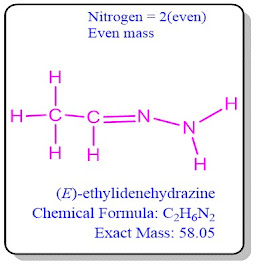
Any molecule (with all paired electrons) containing an odd number of nitrogen atoms will have an odd nominal mass, according to the nitrogen rule. The integer mass of an atom, ion, or molecule made up exclusively of the most stable isotope is known as the nominal mass (s).

This rule is used when molecules have only carbon, Nitrogen, Hydrogen, Oxygen, and Halogen atoms.

Here below are examples that are helpful for understanding the Nitrogen rule, you will be able to find out the molecular formula of the unknown compound by using this rule.

Compounds containing an even or odd number of nitrogen atoms their molecular weight will also be even or odd respectively. Even or no nitrogen atom in molecules means its molecular weight will be even.  


Nitrogen Rule

Nitrogen Rule
Nitrogen Rule
Nitrogen Rule